
Car Hauler Trailers
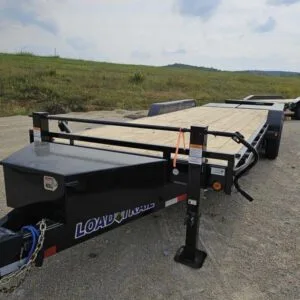
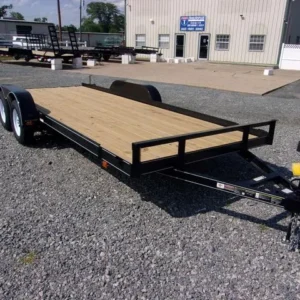
The most common mistake on an open car hauler is buying on length and ignoring the axles. A 7,000-pound GVWR trailer on twin 3,500-pound axles sounds like plenty until you subtract the roughly 2,200 pounds the trailer itself weighs, leaving about 4,800 pounds of payload. A midsize sedan fits. A half-ton pickup, a full-size SUV, or a project car with a trailer full of tools and a spare engine does not. Do that subtraction before you shop.
Car Hauler Sizes & Capacities
Widths below are measured between the fenders, which is the number that decides whether a car's tires clear. A "102-inch" hauler is a deckover — the deck sits above the tires, giving you full width but a taller deck and a steeper ramp angle.
| Size | Axles | GVWR | Approx. payload | What it carries comfortably |
|---|---|---|---|---|
| 7' × 16' | 2 × 3,500 lb | 7,000 lb | ~4,800 lb | Compact and midsize cars, small classics |
| 82" × 18' | 2 × 3,500 lb | 7,000 lb | ~4,600 lb | Most sedans and coupes, light track cars |
| 82" × 18'–20' | 2 × 5,200 lb | 9,900–10,400 lb | ~7,300 lb | Full-size trucks, SUVs, car plus tool load |
| 83" × 20'–22' | 2 × 7,000 lb | 14,000 lb | ~10,500 lb | Dually pickups, two small vehicles, race setup |
| 102" × 20'–24' deckover | 2–3 × 7,000 lb | 14,000–21,000 lb | 10,000–16,000 lb | Wide vehicles, dual-car loads, light equipment |
Rough rule for length: measure your vehicle bumper to bumper and add four feet. An 18-foot deck handles vehicles up to about 16 feet, which covers nearly every passenger car. Full-size crew-cab pickups run 19 to 21 feet and belong on a 20 to 22-foot deck. Our trailer sizing guide works through the same math for other load types.
How to Choose the Right Car Hauler
Work the payload math, not the GVWR
Payload is GVWR minus the trailer's own empty weight, and empty weight varies 400 pounds or more between a bare steel deck and a fully optioned unit with a winch plate and toolbox. Then subtract everything riding with the car. See GVWR, GAWR, payload and tongue weight explained if any of those terms are fuzzy.
Between-fender width versus deckover
An 82 or 83-inch between-fender deck is the standard passenger-car answer: the car sits low, the deck sits low, and the ramp angle stays manageable. Deckover trailers at 102 inches solve width problems — dual-rear-wheel trucks, wide-track vehicles, equipment — but you pay for it with a deck sitting several inches higher and a correspondingly steeper approach.
Ground clearance decides your loading setup
Standard 5-foot slide-in ramps against a 21-inch deck produce a load angle around 20 degrees. A stock sedan handles that. A lowered car, a scraper-nose classic, or anything with a front splitter will not. Your options are longer ramps, a beavertail or dovetail deck, or moving to a tilt deck trailer where the whole deck pivots and the angle drops into single digits.
Deck material
Treated pine planking is standard, replaceable, and grippy when wet. Steel tread plate lasts indefinitely but gets slick, adds several hundred pounds of tare weight, and gets hot enough in Arizona summer to matter. Composite and rough-cut oak decks split the difference at a price premium.
Brakes, tires, and the trip you actually take
Brakes on both axles, not just one. Most states require trailer brakes above 3,000 pounds gross, and stopping 7,000 pounds on one braked axle behind a half-ton is a bad plan regardless of what is legal. Check brake laws by state for your route. Radial ST tires in load range D or E, plus a mounted spare and a carrier, are not optional equipment on a long haul.
Ramps, Decks, and Tie-Down Systems
Loading hardware is where two similarly priced trailers diverge. Slide-in ramps store under the deck, weigh 40 to 70 pounds each, and require you to pull and set them by hand every load. Rear-slide or drive-over fenders let you skip that on a short deck. Dovetail or beavertail decks angle the last few feet down permanently, which shallows the approach without any moving parts — the trade is that the tail is no longer flat. Full-width or "car deck" ramps are the premium answer for low cars, since you are not aiming two narrow ramps in a mirror.
For tie-downs, the choice is between stake pockets with rub rails, weld-on D-rings, and recessed wheel-slot or basket systems. Slot tracks and wheel nets are worth the money if you are moving vehicles regularly, because they secure the car by the tires and let the suspension work instead of straining the chassis. Four points, always, with the straps pulling in opposing directions. Grade 70 chain and ratchet binders are correct for equipment, but overkill and paint-hostile on a finished vehicle.
A few more items worth specifying up front: a winch plate at the front of the deck for non-runners, removable fenders if you will ever carry something wider than a car, a spare tire and carrier, LED lighting, and a 2-5/16 inch coupler on anything rated above 7,000 pounds.
Delivery & Buying Online
We ship open car haulers nationwide throughout the lower 48. Freight is quoted flat-rate to your address before you buy, so the delivered price is fixed at the time you commit. All units are backed by our 30-day guarantee. Tell us the year, make, and model you plan to haul and what you are towing with, and we will confirm the trailer clears on both length and payload.
Related Categories
Need the car protected from weather and prying eyes? Compare our enclosed car hauler trailers. For low-clearance vehicles, the tilt deck trailers load far shallower. If you are also moving machinery, look at equipment trailers or the lighter utility trailers for day-to-day use, and see the full trailer inventory to browse everything in stock.
Frequently Asked Questions
What size car hauler do I need?
Measure your vehicle bumper to bumper and add about four feet. An 18-foot deck handles vehicles up to roughly 16 feet, which covers nearly all passenger cars. Full-size crew-cab pickups run 19 to 21 feet and need a 20 to 22-foot deck. Width matters too: 82 inches between fenders fits most cars.
Is a 7,000 lb car hauler enough for my truck?
Usually not. A 7,000-pound GVWR trailer weighs about 2,200 pounds empty, leaving roughly 4,800 pounds of payload. Most half-ton pickups weigh 4,700 to 5,600 pounds before cargo, so you are at or over the rating on arrival. Step up to 5,200-pound axles and a 9,900 to 10,400-pound GVWR.
How do I load a lowered car without scraping?
Reduce the load angle. Standard 5-foot ramps against a 21-inch deck give roughly a 20-degree approach, which is too steep for lowered vehicles. Longer ramps, a dovetail or beavertail deck, or a tilt deck trailer where the whole deck pivots to 8 to 12 degrees will all solve it. Tilt decks are the most reliable fix.
Do I need brakes on both axles of a car hauler?
Yes, on anything rated above 7,000 pounds, and it is strongly recommended below that. Most states require trailer brakes once gross weight exceeds around 3,000 pounds, though thresholds vary. Braking both axles shortens stopping distance substantially and reduces trailer sway under hard braking. Check your state's specific requirement.
Should I get a wood or steel deck?
Treated pine is the practical default: it grips well when wet, costs less, and individual planks are replaceable. Steel tread plate lasts far longer and resists damage from equipment, but adds several hundred pounds of tare weight, gets slippery in rain, and becomes very hot in direct sun.
How should I strap a car to an open trailer?
Use four tie-down points pulling in opposing directions, ideally over the tires with wheel nets or basket straps rather than on the chassis. Tire-based straps let the suspension work normally instead of loading the frame. Avoid chain and binders on finished vehicles; save those for equipment, where paint damage is not a concern.