
45ft Shipping Containers
Shop 45ft shipping containers for sale — the largest standard ISO container built, adding five feet of length over a 40ft high cube for roughly 360 sq ft of enclosed space. Ideal for long-material storage, large workshops, and modular builds. Nationwide delivery available.
Showing the single result
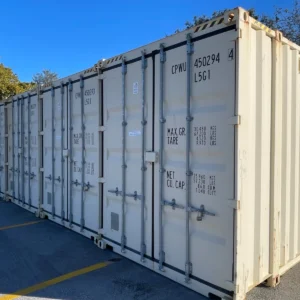
45ft Shipping Containers for Sale
The 45ft is the longest standard ISO container built — designation 1EEE — and it exists for one reason: maximum enclosed volume on a single footprint. At roughly 341 sq ft of floor and 3,040 cu ft of interior, it is the largest single box you can have delivered without fabrication.
It is also a specialist buy. Availability is thinner, road permitting is stricter, and the extra five feet make an already difficult delivery harder. If your load does not specifically need 44ft of unbroken interior length, a 40ft high cube is easier to source, cheaper to freight, and easier to site.
45ft vs 40ft High Cube
The comparison that matters. A 45ft is a high cube by definition — there is no 8'6" variant in production — so the honest question is whether the extra 5ft of length earns its cost.
| Specification | 45ft High Cube | 40ft High Cube | Difference |
|---|---|---|---|
| External L × W × H | 45'0" × 8'0" × 9'6" | 40'0" × 8'0" × 9'6" | +5'0" length |
| Internal L × W × H | 44'5" × 7'8" × 8'10" | 39'5" × 7'8" × 8'10" | +5'0" length |
| Door opening (W × H) | 7'8" × 8'5" | 7'8" × 8'5" | identical |
| Floor area | ~341 sq ft | ~302 sq ft | +39 sq ft |
| Internal volume | ~3,040 cu ft | ~2,694 cu ft | +346 cu ft |
| Tare (empty) weight | ~10,500 lb | ~8,750 lb | +1,750 lb |
| Max gross weight | 71,650 lb | 67,200 lb | +4,450 lb |
| Max payload | ~61,000 lb | ~58,400 lb | +2,600 lb |
Nominal figures; the CSC plate governs any individual unit. Note the door opening is the same on both — the 45ft gains nothing at the entrance, only in depth. Comparative measurements across every size are in our container dimensions guide.
Long-Material Storage
The 44'5" internal length is the whole point. Anything sold in 40ft lengths — structural steel, irrigation pipe, electrical conduit, PVC, extruded aluminium, roof trusses, drill stem, 40ft rebar — will not go into a 40ft container, because a 39'5" interior is five inches short of the material and leaves you nothing to work with. A 45ft swallows a 40ft stick with room to load and unload it.
Beyond long goods, 45ft boxes suit warehousing overflow billed by the pad, equipment dealers storing implements end to end, and conversions where the extra length fits a full layout plus mechanical space in one box rather than two.
Delivering and Siting a 45ft Box
Everything that makes a 40ft delivery difficult is worse here.
- Clearance. Budget 110–120ft of straight, level, obstruction-free run behind the drop point, and roughly 160ft of total working length for the rig. As with a 40ft, the truck must approach straight and leave straight — a 45ft cannot be swung into position.
- Overhead. 15ft minimum for the tilt bed to raise.
- Road access. A 45ft on a chassis exceeds standard legal length in several states without a permit, and low bridges and tight ramps constrain routing. We check the route before quoting.
- Blocking. Six support points minimum — four corner castings plus the midpoints — on compacted gravel, pavers or concrete. A 45ft frame is long enough to sag visibly on an uneven pad, and the doors will tell you immediately.
- Crane sets. Where a tilt-bed cannot reach, a 45ft goes in off a flatbed by crane. At over 10,000 lb empty this is a real lift, not a forklift job.
Availability and Condition
45ft units reach the used market in far smaller numbers than 20ft and 40ft boxes, and stock moves quickly — this category typically holds one unit at a time. Most are wind & watertight or cargo worthy rather than new one-trip, simply because fewer are built. Cargo worthy matters more here than on most sizes: a 45ft still in ocean rotation holds resale value a retired storage box does not. Our grades explained guide covers what each survey certifies. If the unit you need is not on the page today, ask — we source against orders.
Related Categories
- 40ft shipping containers — easier to source, cheaper to freight, five feet shorter
- 20ft shipping containers — the practical choice for constrained sites
- All shipping containers — every size in stock
- Container chassis and trailers — 45ft-capable chassis for road transport (what is a container chassis?)
- Flatbed trailers — long-material hauling and crane-set deliveries
- Shop all inventory
Frequently Asked Questions
Is a 45ft container always a high cube?
Yes. The 45ft is produced only in the 9'6" high cube height, giving 8'10" of interior headroom and an 8'5" door opening. There is no standard-height 8'6" version in production, so any 45ft container you are quoted is a high cube by definition.
How much longer is a 45ft than a 40ft high cube?
Exactly five feet externally and five feet internally — 44'5" of usable length versus 39'5". That adds about 39 sq ft of floor and 346 cu ft of volume. The door opening is identical on both, so the gain is entirely in depth.
Are 45ft containers hard to find?
Yes, relative to 20ft and 40ft. Far fewer are built and they cycle out of ocean service in smaller numbers, so used stock is thin and moves fast. Most available units are wind and watertight or cargo worthy rather than new one-trip. We source against orders.
Can a 45ft container be delivered on a tilt-bed truck?
Usually, but it needs 110 to 120ft of straight, level run behind the drop point and around 160ft of total working length. Road routing is also tighter — a 45ft exceeds standard legal length in several states without a permit, so we verify access before quoting.
What do people store in 45ft containers?
Mainly long material that will not fit a 40ft: structural steel, irrigation pipe, conduit, PVC, roof trusses and 40ft rebar all need more than the 39'5" a 40ft gives. Beyond that, high-volume warehouse overflow and conversion projects needing a single long box.
How much does an empty 45ft container weigh?
About 10,500 lb, roughly 1,750 lb more than a 40ft high cube. Maximum gross weight is 71,650 lb rather than the 67,200 lb of a 40ft, giving around 61,000 lb of payload. The CSC plate on the door carries the exact rating for that unit.