
Container Chassis and Trailers
Shop container chassis for sale — purpose-built trailers for transporting 20ft and 40ft ISO shipping containers. We stock gooseneck and tandem-axle container chassis with heavy-duty twist locks, air brake systems, and DOT lighting, plus equipment and utility trailers rated for container work. Nationwide delivery available.
What a Container Chassis Actually Is
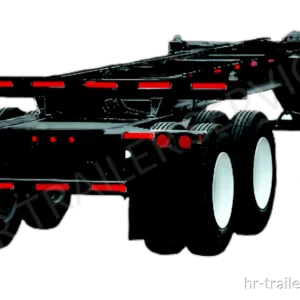
A container chassis is a skeletal semi-trailer with one job: carry an ISO shipping container and nothing else. No floor, no sides, no ramps — the container is the deck. Twist locks at the corners rotate into the box's ISO corner castings, and once locked, container and frame behave as one structural unit. That is why a chassis is so light for what it carries, and why it is useless the moment you need to haul lumber or a skid steer. New to it? Start with what a container chassis is.
Chassis Types and Where Each One Earns Its Keep
20 ft chassis
Fixed length, tandem axle, built around a single 20 ft box. Lightest and cheapest on the lot, easiest to maneuver in tight yards and city drayage. The trade is obvious: it hauls one size. Weight is where 20 ft chassis get interesting — a loaded 20 ft box can hit its 67,200 lb maximum gross, and that much cargo on a short wheelbase creates axle-loading problems a tandem cannot always solve legally.
40 ft gooseneck chassis
The workhorse of the intermodal fleet. "Gooseneck" here means the dropped front neck that clears the tractor's fifth wheel and lets the container sit low — nothing to do with a pickup gooseneck hitch. Most 40 ft chassis also carry 20 ft boxes on forward or center twist lock positions, which is why fleets buy them for mixed work. Sliding tandems let you shift the axle group after loading — often the difference between legal and a citation.
Extendable and sliding chassis
An extendable chassis telescopes so one trailer legally handles 20 ft, 40 ft and often 45 ft containers. Pull a pin, slide the rear section, drop the pin back in. It costs more, adds several hundred pounds of tare, and adds a wear point. For mixed box sizes, it replaces two trailers.
Tri-axle and combo chassis
Tri-axle chassis exist for one reason: weight. Federal gross on the interstate system is 80,000 lb, and axle-group limits under the bridge formula cap what any tandem legally carries. A third axle buys capacity. Heavy 20 ft loads — stone, flexitank liquids, scrap — are the classic case; the cost is tare, tire wear and maneuverability. Combo chassis take multiple configurations off one frame, typically a 40 ft plus dual 20 ft positions.
| Chassis type | Container size carried | Axles | Typical tare weight |
|---|---|---|---|
| 20 ft fixed | One 20 ft | Tandem | ~5,000–6,500 lb |
| 40 ft gooseneck | One 40 ft, or 20 ft in fixed positions | Tandem (often sliding) | ~6,500–7,800 lb |
| 20–40 ft extendable | 20 ft, 40 ft, often 45 ft | Tandem | ~7,300–8,600 lb |
| 40 ft tri-axle | One 40 ft, heavy loads | Tri-axle | ~8,500–10,000 lb |
| 20 ft tri-axle | One heavy 20 ft | Tri-axle | ~7,000–8,500 lb |
| Combo / multi-position | 40 ft or two 20 ft | Tandem or tri | ~7,500–9,000 lb |
Treat those tare figures as ranges, not quotes — frame gauge, sliding tandems, wheel choice and air ride each move the number by hundreds of pounds. We give you the scale weight on the unit itself.
Twist Locks, Corner Castings and How the Box Locks Down
Intermodal interchange rests on two ISO standards. ISO 1161 defines the corner fitting — the cast steel block at each of a container's eight corners, roughly 7" x 7" x 4-1/2" (180 x 180 x 110 mm), with an oval aperture about 124.5 mm on the long axis and 63.5 mm across the flats. ISO 668 sets container lengths so shorter boxes joined with standard twist locks line up into longer rigid units.
The twist lock itself is a cone roughly 104 mm long and 56 mm wide that drops through the aperture and rotates 90 degrees to lock; individual locks are commonly rated at 20 or 25 tonnes tensile. Four of them, engaged and pinned, hold the box against anything a highway generates. The habit that matters: after setting a box, walk all four corners and confirm each lock is fully rotated and the handle secured. A partially engaged twist lock looks correct from the tractor mirror and is not. See our shipping container dimensions reference before you spec.
Weight: the Number That Decides Everything
A 20 ft dry container tares around 4,850–5,300 lb; a 40 ft runs roughly 8,000–8,800 lb and a high cube a bit more. Maximum gross for a standard 20 or 40 ft box is 67,200 lb (30,480 kg). Against an 80,000 lb legal gross — tractor at roughly 17,000–19,000 lb, chassis at 6,500–7,800 lb — maybe 53,000–56,000 lb remains for container and cargo. That is why heavy 20 ft freight rides tri-axles and why every pound of tare matters.
How to Choose a Container Chassis
- Box sizes you actually haul. One size, every day, off the same terminal? Buy fixed. Mixed 20/40/45? Extendable, and skip the second trailer.
- Loaded weight, honestly assessed. If your typical gross puts a tandem near its axle limits, buy the tri-axle now, not after the first ticket.
- Sliding versus fixed tandems. Sliders let you correct axle loading after the box is on — worth it on any operation weighing at a scale.
- Suspension. Spring ride is cheaper; air ride treats freight and frame better on fragile cargo.
- Wear points. Twist locks, landing gear, brake chambers, slack adjusters, king pin, lights. On used chassis these are the whole inspection.
- Regulatory obligations. Chassis offered for interchange fall under FMCSA intermodal equipment provider rules, with inspection and recordkeeping duties.
When a Flatbed or Tilt Deck Is the Better Buy
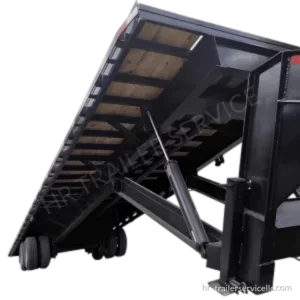
Buy a chassis only if containers are the recurring job. If you move a box occasionally and equipment or lumber the rest of the time, a chassis is dead capital. A flatbed trailer carries a container plus everything else and loads with a forklift instead of a top-pick. A tilt deck trailer adds ground-level loading for rolling equipment. A roll-off trailer suits placing and retrieving boxes at job sites, and for oversize machinery a detachable gooseneck beats all of them.
Delivery & Buying Online
We ship chassis and trailers nationwide throughout the lower 48. Freight is quoted flat-rate before you commit — no surprise accessorial charges at delivery — and every unit carries our 30-day guarantee. Send us the delivery ZIP.
Related Categories
Buyers here also look at shipping containers themselves — a 20 ft container for on-site storage or a 40 ft high cube for volume. For machinery instead of boxes, see equipment trailers, and for chassis wear parts, heavy equipment and trailer parts.
Frequently Asked Questions
What is a container chassis?
A container chassis is a skeletal semi-trailer built to carry an intermodal shipping container and nothing else. Twist locks at the corners engage the container's ISO corner castings so the box itself becomes the structural deck. There is no floor, no sides and no ramps, which is why chassis are comparatively light.
How much does a 40 ft container chassis weigh?
Most 40 ft tandem-axle container chassis tare between roughly 6,500 and 7,800 lb, depending on builder, frame spec and whether it has sliding tandems. A 20 ft chassis typically runs 5,000 to 6,500 lb, and a 40 ft tri-axle 8,500 to 10,000 lb. Always confirm the scale weight on the specific unit.
Can a 20 ft chassis carry a 40 ft container?
No. A 20 ft chassis has neither the length nor the twist lock spacing to secure a 40 ft container, and no legitimate workaround exists. A 40 ft chassis, however, will usually carry a 20 ft box on fixed forward or center twist lock positions, which is why fleets running mixed sizes buy 40s.
Do I need a tri-axle container chassis?
You need one when loaded weight pushes a tandem past its legal axle limits. A 20 ft container loaded near its 67,200 lb maximum gross cannot legally ride a tandem chassis within the 80,000 lb federal gross limit and bridge formula. Heavy commodities like stone, liquids and scrap are the standard tri-axle case.
What is an extendable container chassis?
An extendable, or sliding, chassis telescopes so one trailer legally carries 20 ft, 40 ft and often 45 ft containers. It costs more and adds several hundred pounds of tare compared to a fixed-length chassis, but for an operator handling mixed box sizes it does the work of two separate trailers.
Should I buy a container chassis or a flatbed trailer?
Buy a chassis only if you haul ISO containers regularly. A flatbed or tilt deck carries containers plus equipment, lumber and machinery, and can be loaded by forklift rather than requiring a top-pick or crane. A chassis is faster and safer for containers specifically, but it does nothing else.