
9ft Shipping Containers
Shop 9ft shipping containers for sale — a compact steel storage container for sites that cannot take a 20ft delivery. Wind & watertight construction, cargo doors with lock box, and the same marine-grade steel as full-size units. Nationwide delivery.
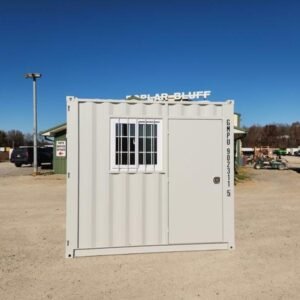
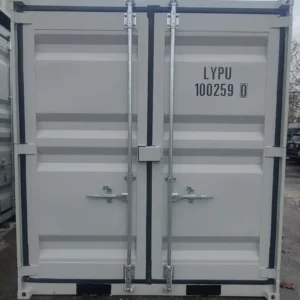
9ft Shipping Containers for Sale
The 9ft is a compromise size, and it earns its place honestly. It exists for sites where a 20ft is out of the question but an 8ft leaves you short — roughly 63 sq ft and 500 cu ft, a foot deeper than an 8ft and a foot shallower than a 10ft.
Be clear-eyed about it: this is an uncommon size. If your site can accept a 10ft, take the 10ft — it is a recognised ISO length, easier to source and easier to resell. Buy the 9ft when a measured constraint puts 10ft out of reach.
The Gap Between 8ft and 10ft
Nine feet is not an ISO 668 length. The standard covers 45ft, 40ft, 30ft, 20ft and 10ft, with nothing between. No 9ft container has ever carried ocean cargo, and none exists as a factory ISO build.
What is on the market is fabricated. Most 9ft units are cut down from a 20ft or 40ft ISO container, with a new end wall welded in and the roof and floor terminated at the cut. A smaller share are purpose-built from container-grade Corten steel with cargo-style doors and corner castings. The 9ft length usually exists because a fabricator was working to a customer's specific site dimension — which is why it shows up in ones and twos rather than in volume. Each listing states the construction.
9ft Container Specifications
| Specification | Typical figure | Notes |
|---|---|---|
| External L × W × H | 9'0" × 8'0" × 8'6" | Width and height follow ISO; length does not |
| Internal L × W × H | ~8'3" × 7'8" × 7'10" | Length varies with end-wall build |
| Door opening (W × H) | ~7'8" × 7'6" | Original ISO door end if cut down |
| Floor area | ~63 sq ft | vs ~56 sq ft (8ft), ~71 sq ft (10ft) |
| Internal volume | ~500 cu ft | vs ~440 cu ft (8ft), ~560 cu ft (10ft) |
| Tare (empty) weight | ~2,400–2,800 lb | Varies by construction method |
| Certified payload | None rated | No CSC plate on fabricated units |
Treat these as typical rather than specified. Because there is no governing standard, internal length in particular moves by several inches depending on how the fabricator handled the cut and the replacement end wall — measure the actual unit before you build shelving or racking to fit. Standardised figures for the true ISO sizes are in our container dimensions guide.
Who Buys a 9ft
Buyers working to a hard dimension. A parking stall with a bollard at one end, a side yard bounded by a gate and a meter, a shop bay with a specific setback — the common thread is that someone measured, found 10ft would not clear, and needed more than 8ft gave them. Beyond that: residential lots under HOA size limits, contractors wanting secured tool storage at a job house, and gate-side feed and tack storage.
Delivery and Handling
Site requirements sit between an 8ft and a 10ft and are modest. A tilt-bed needs about 35–40ft of straight run behind the drop point plus the truck ahead of it, and 14ft of overhead clearance. More usefully, at 2,400–2,800 lb empty a 9ft can be set by a 6,000–8,000 lb forklift or a small crane off a flatbed — which removes the straight-approach requirement entirely and is how most end up placed. Block all four corner points on compacted gravel, pavers or a slab, and check the doors after setting: binding means the box is racked.
Buying an Uncommon Size
Two practical consequences. First, stock is thin — this category usually holds a single unit, and when it sells we source against orders. Tell us your dimensions and timeline rather than waiting for the page to refresh. Second, inspect the fabrication, because it is the variable. Look for continuous weld at the new end wall rather than tacks, no paint bubbling along the seam, intact roof camber, and a capped floor edge. Confirm local rules first with our permits and zoning guide — small containers are the ones HOAs most often regulate by dimension.
Related Categories
- 10ft shipping containers — one foot more and a recognised ISO length
- 8ft shipping containers — the smallest footprint we stock
- 20ft shipping containers — the standard choice where access allows
- All shipping containers — the full size range compared
- Tilt deck trailers and equipment trailers — move a small container without a forklift
- Shop all inventory
Frequently Asked Questions
Why would I buy a 9ft container instead of a 10ft?
Only if a measured site constraint rules out the 10ft. A 9ft gives about 63 sq ft against 71 sq ft, so you lose usable depth for no saving in width or height. Where 10ft fits, buy the 10ft — it is a recognised ISO length and easier to resell.
Is a 9ft container an ISO standard size?
No. ISO 668 covers 45ft, 40ft, 30ft, 20ft and 10ft lengths with nothing in between, so no 9ft container has ever carried ocean cargo. Every 9ft unit is fabricated — usually cut down from a 20ft or 40ft box, occasionally purpose-built.
How much does a 9ft container weigh?
Roughly 2,400 to 2,800 lb empty, though it varies more than ISO sizes because construction is not standardised. Cut-down units keep the heavier original frame members and tend toward the top of that range. Fabricated units carry no CSC plate or certified payload rating.
How is a 9ft container built?
Most are sectioned from a 20ft or 40ft ISO container, with a new end wall welded in and the roof and floor terminated at the cut. The door end is normally the untouched original. A minority are purpose-built from container-grade Corten steel with cargo-style doors.
Can a 9ft container be delivered to a residential lot?
Usually with ease. A tilt-bed needs about 35 to 40ft of straight run plus truck length and 14ft overhead, but at under 2,800 lb empty the box can also be set by forklift or small crane off a flatbed — which removes the straight-approach requirement entirely.
Are 9ft containers stackable?
Treat them as not stackable. Corner castings on a cut-down unit are only as strong as the fabricator's weld at the new end, and there is no CSC plate certifying a stacking rating. Even where castings look original, we do not recommend stacking modified boxes.