
Dump Trailers
Browse hydraulic dump trailers for sale at the best prices. Mini dump trailers to heavy-duty 7×14 dump trailers rated from 5,200 to 14,000 lbs GVWR. Features include 12V/24V hydraulic scissor hoists, removable 18″–36″ steel sides, 3-way rear gates, electric brakes, and tarp kits. Perfect for landscaping, excavation, and construction. Buy a dump trailer online — nationwide shipping available.
Showing 1–12 of 24 results
-
Dump Trailers
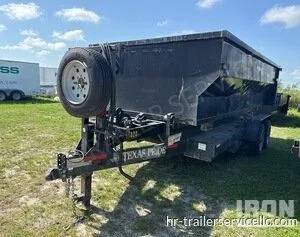
2021 Texas Pride RO71618KGN T/A Roll-Off Trailer w/ Extra Dump Bed
$6,000 Add to cart -
Dump Trailers
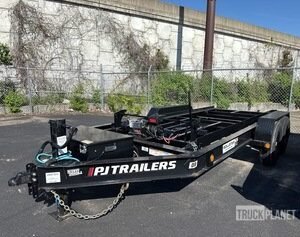
2022 PJ 1D192 T/A Roll-Off Trailer
$4,200 Add to cart -
Dump Trailers
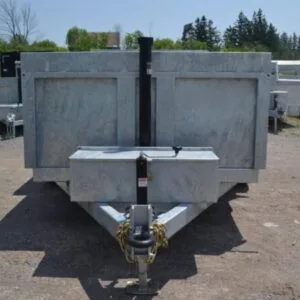
2023 Advantage 6X12 5 Ton Dump Trailer
$12,897 Add to cart -
Dump Trailers

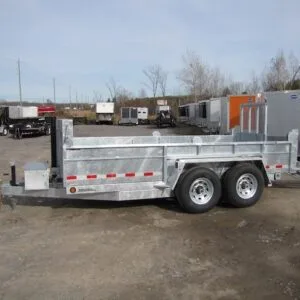
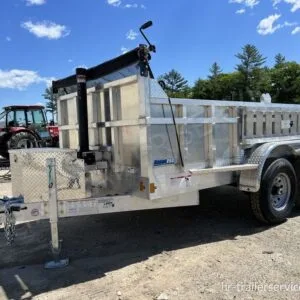
2023 Advantage 7 Ton 14FT Galvanized Dump Trailer
$14,630 Add to cart -
Dump Trailers
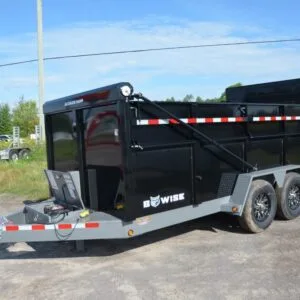
2023 B Wise 14′ Ultimate Dump
$28,900 Add to cart -
Dump Trailers
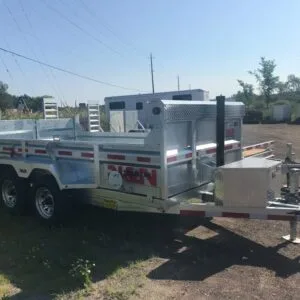
2023 N&N 5 Ton 6’X12′ Galvanized Dump Trailer
$12,985 Add to cart -
Dump Trailers
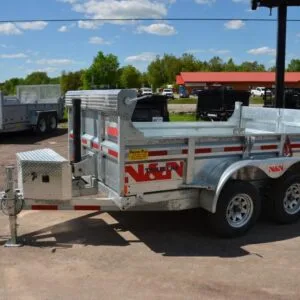
2023 N&N 6×10 Galvanized 5T Dump Trailers
$18,600 Add to cart -
Dump Trailers
Sale!
2024 Cargo Pro Dump Trailer
Original price was: $10,600.$8,480Current price is: $8,480. Add to cart -
Dump Trailers
Sale!
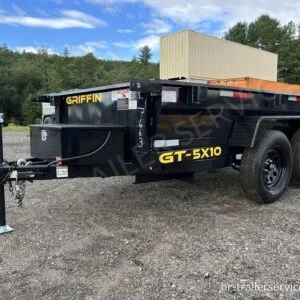
2024 Griffin Trailers 5×10 7K Powder Coated Dump w/Barn Door Gate
Original price was: $4,450.$3,560Current price is: $3,560. Add to cart -
Dump Trailers
Sale!
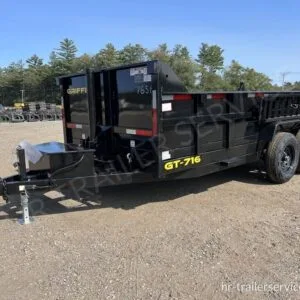
2024 Griffin Trailers 7×16 14K Telescopic Dump Trailer w/Ramps & Spare Tire Mount
Original price was: $7,000.$5,600Current price is: $5,600. Add to cart -
Dump Trailers
2024 Maxey T/A Roll-Off Trailer
$6,000 Add to cart -
Dump Trailers
Sale!
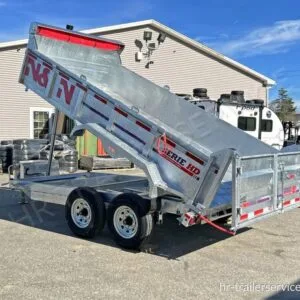
2024 N&N Trailers 7×14 14K Galvanized Hydraulic Dump w/Ramps, 2-Way Spreader Gate & Tarp Kit
Original price was: $10,600.$8,480Current price is: $8,480. Add to cart
Dump Trailer Sizes & Capacities
Dump trailer buyers usually shop by cubic yards and then get caught by weight. Volume and weight are different limits, and with dense material you'll hit the weight limit long before the box is full. Gravel runs about 2,700 lb per cubic yard, wet sand 2,800–3,000 lb, topsoil 2,000–2,400 lb, asphalt millings around 2,700 lb, and dry mulch only 400–800 lb. A 14,000 lb trailer holding 14 cubic yards of mulch is fine; the same box with 4 yards of wet gravel is at its limit.
| Size | Side Height | GVWR | Payload | Volume (level) | Gravel It Can Legally Carry |
|---|---|---|---|---|---|
| 5' x 10' | 24" | 7,000 lb | 4,600–5,000 lb | ~3.7 cu yd | ~1.8 cu yd |
| 6' x 10' | 24" | 9,990 lb | 7,000–7,500 lb | ~4.4 cu yd | ~2.7 cu yd |
| 6' x 12' | 24" | 9,990–12,000 lb | 7,000–9,000 lb | ~5.3 cu yd | ~2.9 cu yd |
| 7' x 14' | 24" | 14,000 lb | 9,400–10,200 lb | ~7.3 cu yd | ~3.6 cu yd |
| 7' x 14' | 48" (with sides) | 14,000 lb | 9,400–10,200 lb | ~14.5 cu yd | ~3.6 cu yd |
| 7' x 16' | 24" | 16,000 lb | 10,800–11,600 lb | ~8.3 cu yd | ~4.1 cu yd |
| 7' x 16' gooseneck | 36" | 21,000–24,000 lb | 14,500–17,000 lb | ~12.4 cu yd | ~5.6 cu yd |
The lesson: buy side extensions for light, bulky material (mulch, leaves, brush, cardboard) and buy axle capacity for dense material. Ordering 4-foot sides on a 14,000 lb trailer doesn't raise the legal load by an ounce.
How to Choose the Right Dump Trailer
Decide what you'll haul most
Demolition debris and landscape waste are volume-limited — get the bigger box and tall sides. Aggregate, soil, and millings are weight-limited — get the bigger axles and don't pay for a box you can never fill.
Pick the hoist type deliberately
This is the component that determines whether the trailer still works in year eight. Single-ram hoists are the cheapest and dump fine when loaded evenly, but they struggle with off-center loads. Scissor hoists lift far more at the start of the stroke and handle heavy, sticky material best — the preferred choice for aggregate and clay. Telescopic (multi-stage) hoists mount at the front and give the steepest dump angle, which is what you want for anything that packs, but they need a straighter, more evenly distributed load. Dual-piston direct-lift systems are simple and reliable but give the shallowest angle.
Look at the door configuration
A combo barn/spreader gate is the standard: open it fully to dump a pile, or latch it at the top to spread gravel as you drive. Double barn doors are best for loading a machine up the ramps. High-lift tailgates swing above the load for clean release with wet material.
Check the ramps
Most dump trailers include slide-in ramps so you can drive a mini excavator, walk-behind, or skid steer into the box. Confirm the ramp rating separately from the trailer rating — ramps are often the weakest link.
Confirm the power system
Look for a sealed pump box, a deep-cycle battery, a charge line from the tow vehicle, an on-board trickle charger, and a corded remote with a manual override. A dump trailer with a dead battery in a customer's driveway is a wasted day.
Body Construction, Hydraulics, and Frame
Floor gauge is the number that matters most for longevity. 10-gauge floors handle aggregate and demolition debris; 12-gauge is adequate for soil and landscape work; anything thinner will dent and eventually tear where material drops. Sides are typically 12- or 14-gauge with formed top rails and vertical side ribs — ribs prevent the belly bulge that develops on smooth-sided boxes carrying wet material.
Under the box you want an I-beam or heavy channel mainframe with a full-length subframe supporting the floor, plus crossmembers on 12"–16" centers. Watch for the rear hinge point: it takes enormous load every time the box comes up, and heavy gussets there separate the trailers that stay square from the ones that don't.
Hydraulics should be a name-brand pump with an accessible reservoir and hoses routed inside the frame rather than exposed. Cylinders on 14,000 lb trailers typically run 3.5"–4" bore. Check the fluid annually, keep the pivot pins greased, and never leave the box raised while parked on a slope — it puts side load into the hoist that it was never designed to take.
Tarps are a legal requirement in most states for loose material, and a manual crank tarp is cheap insurance against citations and cracked windshields behind you. An electric tarp on a larger trailer pays for itself in time saved.
Delivery & Buying Online
Dump trailers ship nationwide to the lower 48 with a flat-rate freight quote given before you buy. Every trailer carries our 30-day guarantee. Tell us your typical material and haul distance and we'll match the hoist type, floor gauge, and axle rating to the work.
Related Categories
If you're hauling machinery rather than material, see equipment trailers. For higher-capacity dumping behind a pickup, look at gooseneck trailers, and for containerized waste hauling compare roll off trailers. Open hauling without the hoist is covered under utility trailers, and hydraulic cylinders, pumps, and axles are stocked in trailer parts.
Frequently Asked Questions
How much can a 7x14 dump trailer haul?
A 7' x 14' dump trailer with a 14,000 lb GVWR carries roughly 9,400 to 10,200 lb of payload after subtracting its own weight. That's about 3.5 cubic yards of gravel, 4 to 4.5 yards of topsoil, or a full box of mulch. Volume rarely limits you with dense material.
How many yards is a 6x12 dump trailer?
A 6' x 12' dump trailer with 24-inch sides holds about 5.3 cubic yards level full, or roughly 10.5 yards with 4-foot side extensions. Weight limits it well before volume does with heavy material: at 9,990 lb GVWR you can legally load only about 2.9 yards of gravel.
What's the difference between a scissor hoist and a telescopic hoist?
A scissor hoist produces the most lifting force at the start of the stroke, making it best for heavy, sticky, or unevenly loaded material. A telescopic hoist mounts at the front and delivers a steeper dump angle, which clears packed material better but needs a straighter, more evenly distributed load.
Can you drive a skid steer into a dump trailer?
Yes, most dump trailers include slide-in ramps and double barn doors for exactly this. Confirm the ramp rating separately from the trailer GVWR, since ramps are often the limiting component. Also verify the machine plus trailer weight stays inside the GVWR, which rules out larger track loaders on 14,000 lb trailers.
What thickness should a dump trailer floor be?
10-gauge steel for aggregate, rock, and demolition debris; 12-gauge is acceptable for soil, mulch, and general landscape work. Thinner floors dent where material drops and eventually tear at the stress points. Side panels are commonly 12 or 14 gauge with vertical ribs to prevent bulging.
Do I need a tarp on a dump trailer?
Yes in most states, any loose material hauled on a public road must be covered. A manual crank tarp is inexpensive and covers standard side heights; electric tarps are worth it on larger trailers or high daily cycle counts. Uncovered loads risk citations and windshield damage to vehicles behind you.