
8ft Shipping Containers
Shop 8ft shipping containers for sale — the smallest steel storage container we stock, easy to place in a garage bay, a narrow side yard, or a crowded job site while still giving full weatherproof, lockable security. Delivered nationwide.
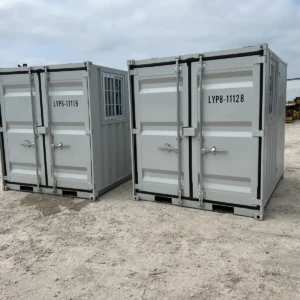
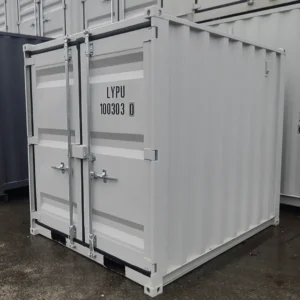
8ft Shipping Containers for Sale
An 8ft container is the smallest steel storage box worth buying — about 56 sq ft, an 8ft by 8ft footprint, and roughly a ton empty. It occupies less ground than a single parking space, which is precisely why people buy it. If your available spot is a side yard, an alley return, a rooftop deck, or one bay of a shop, this is the size that goes there.
Understand up front what you are buying. This is not a scaled-down ocean container, and any seller who implies otherwise is selling you a story.
Not an ISO Size — What You Are Actually Buying
ISO 668 standardises container lengths at 45ft, 40ft, 30ft, 20ft and 10ft. There is no 8ft in the standard. No 8ft box has ever moved cargo in ocean service, and none carries a CSC plate from an ISO build.
Every 8ft container on the market is one of two things. Either it is purpose-built from container-grade Corten steel to container proportions — corner castings, cargo doors, marine-ply or steel floor, but manufactured as a storage unit from the start. Or it is cut down from a 20ft or 40ft ISO box by a fabricator, with a new end wall welded in. Purpose-built units are generally more consistent; cut-downs use genuine ocean-container steel and hardware and are only as good as the weld work. Neither is inferior for storage. Both are simply different from what "shipping container" implies, and each listing states which construction the unit is.
8ft Container Specifications
| Specification | Typical figure |
|---|---|
| External L × W × H | 8'0" × 8'0" × 8'6" |
| Internal L × W × H | ~7'3" × 7'8" × 7'10" |
| Door opening (W × H) | ~7'8" × 7'6" |
| Floor area | ~56 sq ft |
| Internal volume | ~440 cu ft |
| Tare (empty) weight | ~2,000–2,600 lb |
| Construction | Purpose-built or modified — not ISO 668 |
These are typical figures, not standardised ones — and that distinction is the practical takeaway. Because no ISO spec governs the size, external height varies (some purpose-built units run 7'0" or 7'6" tall rather than 8'6"), door openings differ by builder, and floor construction ranges from marine ply to steel tread plate. Always work from the measured dimensions on the specific listing rather than a generic chart. Standardised figures for the ISO sizes are in our shipping container dimensions guide.
Placement: Side Yards, Shop Bays and Rooftops
The 8ft's value is entirely spatial. Its footprint fits inside a standard parking stall, along a fence line a 20ft would overrun by twelve feet, or in the dead corner of a shop. At roughly a ton empty it is within reach of a 5,000 lb forklift or a small crane — so it can be lifted over a fence and set on a rooftop, loading dock or courtyard no truck will ever enter.
Typical buyers: homeowners with no shed room and an HOA that will not permit a larger box, trades needing secured tool storage at a residential site, groundskeepers storing chemicals off-structure, event vendors, and marinas providing tenant lockers. One clarification worth stating plainly: an 8ft container will not fit through a standard garage door — it is 8ft wide and 8'6" tall against a typical 8ft by 7ft opening. It fits the footprint of a garage bay, not the doorway.
Delivery and Setting
A tilt-bed needs only about 35ft of straight run behind the drop point plus truck length, with 14ft overhead. More often the 8ft goes in on a flatbed and is set with a forklift or small crane — which is the whole reason to choose the size, since placement is precise and needs no straight-line truck approach at all. Block the four corners on compacted gravel, pavers or a slab; door binding is still the symptom of a bad set. Condition grading works as on any container — see our grades explained guide.
Related Categories
- 9ft shipping containers — one foot more, same placement advantages
- 10ft shipping containers — a recognised ISO length with more usable depth
- 20ft shipping containers — the standard box, if the site can take it
- All shipping containers — compare every size
- Equipment trailers and tilt deck trailers — haul a small container yourself
- Shop all inventory
Frequently Asked Questions
Are 8ft shipping containers standard ISO containers?
No. ISO 668 standardises 45ft, 40ft, 30ft, 20ft and 10ft lengths — there is no 8ft in the standard and none has carried ocean cargo. Every 8ft unit is either purpose-built from container-grade steel or cut down from a 20ft or 40ft box.
How much does an 8ft container weigh?
Roughly 2,000 to 2,600 lb empty, varying more than ISO sizes because construction is not standardised. Purpose-built units are generally lighter than cut-downs, which retain the heavier ISO frame members. Check the measured weight on the individual listing rather than assuming.
Will an 8ft container fit in my garage?
It fits the footprint of a single garage bay but will not pass through the door. An 8ft container is 8ft wide and 8'6" tall against a typical 8ft by 7ft garage opening. It has to be craned or forked into an open-sided space, not driven in.
Can I move an 8ft container myself?
Possibly. At around a ton empty it is within the capacity of a 5,000 lb forklift or a telehandler, and it will ride on a heavy equipment trailer. Lift from the corner castings rather than under the side rails, or you will bend the frame.
How much fits in an 8ft container?
About 56 sq ft of floor and 440 cu ft of volume — comparable to a large garden shed or a 5x10 self-storage unit, but in lockable steel. That covers a full set of hand and power tools, lawn equipment, seasonal stock, or roughly one small room of household goods.
Do 8ft containers come wind and watertight?
Yes, that is the normal grade for the size. Because these are purpose-built or fabricated rather than ocean-surveyed, they carry no cargo worthy certification — the meaningful test is whether the shell, roof seams and door seals keep weather out, which is what wind and watertight covers.