
10ft Shipping Containers
Shop 10ft shipping containers for sale — roughly 80 sq ft of lockable steel storage that fits on a short driveway, a tight job site, or a small back lot where a 20ft unit will not turn. Available new (one-trip) and used wind & watertight. Delivered nationwide.
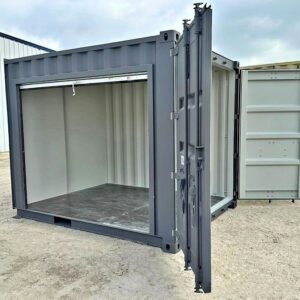
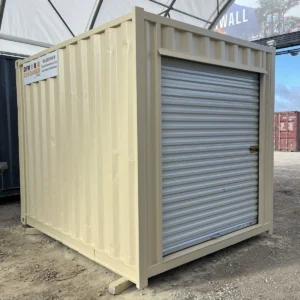
10ft Shipping Containers for Sale
Buy a 10ft container when the site, not the storage requirement, is the constraint. Roughly 71 sq ft of lockable steel goes places a 20ft cannot — behind a house, inside a fenced side yard, in the corner of a shop bay. That is the entire argument for the size, and it is a good one.
What a 10ft is not is cheap per square foot. You will pay a substantial fraction of a 20ft price for less than half the floor. Buyers with room for a 20ft almost always should take it.
Is a 10ft Container a Real ISO Size?
Technically yes, practically no — and this matters when you inspect one. ISO 668 does list a 10ft length under the designation 1D, so the size is standardised on paper. But the ocean fleet abandoned it decades ago because 10ft boxes are inefficient to stack and handle, and essentially none are built new for shipping service today.
So most 10ft containers on the US market are cut-down units — a 20ft or 40ft box sectioned by a fabricator with a new end wall welded in — or purpose-built storage units made from container steel. Some are excellent work; some are not. A dealer who sells you a 10ft as a "standard ISO container" without mentioning this is either uninformed or hoping you are. Each listing states the construction.
10ft Specifications
| Specification | Figure |
|---|---|
| External L × W × H | 10'0" × 8'0" × 8'6" |
| Internal L × W × H | ~9'3" × 7'8" × 7'10" |
| Door opening (W × H) | 7'8" × 7'6" |
| Floor area | ~71 sq ft |
| Internal volume | ~560 cu ft |
| Tare (empty) weight | ~2,600–3,000 lb |
| Nominal max payload | ~21,000 lb |
Figures are nominal. Internal length in particular varies with construction — a cut-down unit's end wall thickness and how the fabricator sections the box both move the number, so measure the specific unit if you are building shelving to fit. Factory 1D units carry a CSC plate; most modified units do not, which is fine for storage but means no certified payload rating. Comparative figures across all sizes are in our container dimensions guide.
Where a 10ft Fits That a 20ft Will Not
At about 3,000 lb empty, the box changes category. It is light enough for a standard 8,000–10,000 lb forklift or a telehandler to set precisely, and small enough that many HOAs treat it as an accessory structure rather than a nuisance.
Typical buyers: homeowners with no side-yard depth, small contractors wanting secured tool storage at a residence, landscapers and pool crews storing chemicals off-site, market vendors, and ranchers needing feed and tack storage at a remote gate. For a workshop or an office conversion, 71 sq ft is genuinely tight and a 20ft is the honest recommendation.
Delivery and Placement
A tilt-bed still needs a straight approach, but only about 40ft of run behind the drop point plus truck length, and 14ft overhead. Where that is impossible, a 10ft is one of the few sizes a forklift or small crane can place economically off a flatbed, which opens up back yards and courtyards no tilt-bed will reach. Block all four corners on compacted gravel, pavers or concrete — a short box is more forgiving of an uneven pad than a 40ft, but set it out of level and the doors will still bind.
What to Inspect on a Cut-Down Unit
The weld work is what you are actually buying. Check the seam where the new end wall meets the original side walls, roof and floor for continuous weld rather than tack-and-fill, and look for paint bubbling along it — that signals rust already working under the coating. Confirm the roof retains its camber. Check how the floor was terminated at the new end, since exposed plywood edge grain wicks water and is the most common failure point. Condition grading still applies on top of that; our grades explained guide covers what wind and watertight commits a seller to.
Related Categories
- 20ft shipping containers — double the floor, far better value if the site allows it
- 8ft shipping containers and 9ft shipping containers — smaller footprints again
- All shipping containers — full size range
- Equipment trailers — for hauling a 10ft box yourself
- Tilt deck trailers — load and unload a small container without a forklift
- Shop all inventory
Frequently Asked Questions
Is a 10ft container a real ISO size?
It is listed in ISO 668 as designation 1D, so it is standardised on paper. In practice the ocean fleet stopped using 10ft boxes decades ago and almost none are built new, so most 10ft containers sold in the US today are cut down from 20ft or 40ft units.
How much does a 10ft shipping container weigh?
Roughly 2,600 to 3,000 lb empty, though modified and cut-down units vary more than factory sizes because the replacement end wall is rarely built to original spec. Factory 1D units carry a CSC plate with the exact tare; most fabricated 10ft boxes do not.
Can a forklift move a 10ft container?
Yes. An empty 10ft is light enough for a standard 8,000 to 10,000 lb forklift or a telehandler with long forks to lift and place precisely. This is a real advantage of the size — it opens up back yards and courtyards no tilt-bed truck can reach.
Why do 10ft containers cost more per square foot than 20ft?
Because most are fabricated rather than mass-produced. Cutting down a 20ft or 40ft box means labour, a new end wall, and finish work, and that cost does not scale down with the floor area. You pay for the small footprint, not for the storage.
What should I check on a cut-down 10ft container?
The weld seam where the new end wall meets the side walls, roof and floor. Look for continuous weld rather than tacks, no paint bubbling along the seam, an intact roof camber, and a properly sealed floor edge. Exposed plywood edge grain is the usual failure point.
How much space do I need for a 10ft container delivery?
About 40ft of straight run behind the drop point plus the truck length, and 14ft of overhead clearance for a tilt-bed. If that is not available, a 10ft is small enough to be set by forklift or small crane off a flatbed, which most larger sizes are not.