
Livestock Trailers
Showing 13–17 of 17 results
-
Gooseneck Trailers
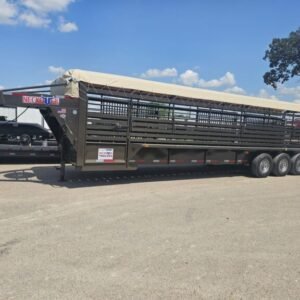
2025 Neckover 32’X6’8″ Stock / Stock Combo Trailer
$23,999 Add to cart -
Gooseneck Trailers
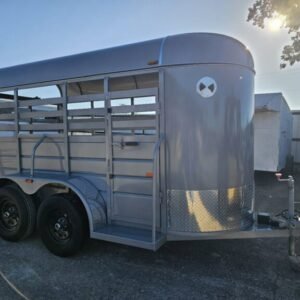
2025 WW AA 5X12 Stock / Stock Combo Trailer
$6,250 Add to cart -
Gooseneck Trailers

2025 WW AA 6X16 Stock / Stock Combo Trailer
$8,900 Add to cart -
Gooseneck Trailers

2026 Big Bend 6’8″X28′ Stock / Stock Combo Trailer
$28,500 Add to cart -
Gooseneck Trailers
2026 W-W Trailer AA 6X14 Stock / Stock Combo Trailer
$8,250 Add to cart
Hauling Animals Is Not Hauling Cargo
A load of steel sits where you put it. Cattle do not. They shift on braking, crowd on corners, and change the trailer's balance every few seconds. That is the whole design brief behind a livestock trailer: airflow through slatted or perforated sides, a floor that gives traction when it is wet and filthy, interior gates to break the load into smaller compartments so animals cannot pile, and enough structure that none of it fails when 12 head lean into one wall at highway speed.
We carry stock and stock-combo trailers from Big Bend, Cornpro, EBY and Adams — steel bumper pulls in the 14 and 16 ft range, and aluminum and steel goosenecks from 20 up to 32 ft.
Sizing by Head Count
Trailer length is really a question about floor area. The working figure most haulers use is roughly 12 to 14 square feet per 1,200 lb mature cow for normal highway hauls. Heavier animals need more, horned cattle need more, hot weather needs more, and a long haul needs more than a run to the sale barn twenty minutes away. Underloading costs you a trip. Overloading costs you an animal.
| Trailer size | Typical GVWR | Approx. head capacity |
|---|---|---|
| 6'8" x 14' bumper pull | 10,000–14,000 lb | 6–8 head |
| 6'8" x 16' bumper pull | 12,000–14,000 lb | 7–9 head |
| 6'8" x 20' gooseneck | 14,000–16,000 lb | 9–12 head |
| 6'8" x 24' gooseneck | 14,000–16,000 lb | 11–14 head |
| 6'8" x 28' gooseneck | 16,000–21,000 lb | 13–16 head |
| 6'8" x 32' gooseneck | 21,000–24,000 lb | 15–19 head |
Those head counts are planning numbers, not guarantees. Run the weight: animals plus trailer tare must stay under GVWR, and the axle capacity has to carry it. A 24 ft gooseneck at 14,000 lb GVWR with a 4,500 lb tare leaves about 9,500 lb of animal — which is closer to eight 1,200 lb cows than fourteen. Weight, not floor space, is the binding constraint more often than people expect. Our guide to GVWR, GAWR, payload and tongue weight walks the math, and what size trailer do I need covers sizing more broadly.
For horses the arithmetic is different: figure roughly four horses loose in a 16 ft, six in a 24 ft, more if the trailer is slant-loaded with dividers.
Bumper Pull or Gooseneck
Go gooseneck once you pass about 20 ft or 14,000 lb. Putting the hitch load over the truck's rear axle instead of behind the bumper transforms how the trailer behaves when animals shift — less sway, better recovery, tighter turning in a sale barn lot, and far more capacity. A bumper pull in the 14 to 16 ft range is genuinely useful for small loads, hooks to any properly equipped three-quarter-ton, and stores easier. Past that size, the gooseneck is not a preference, it is the correct answer. See gooseneck vs bumper pull for the full comparison.
How to Choose a Livestock Trailer
- Size for your biggest routine load, not your largest imaginable one. Buying 32 ft for one annual haul means fighting a 32 ft trailer every other week of the year.
- Aluminum or steel. Aluminum runs roughly 15–25% lighter, does not corrode from manure and urine, and holds resale value — which is why it costs considerably more. Steel is cheaper, repairs with a welder, and takes rough loading. Both are legitimate.
- Count the gates. A center cut gate lets you split a load, sort at the chute, and keep animals from piling forward under braking. Full-swing and half-slide rear gates each have a following; the slider is faster in a tight alley.
- Look at the floor. Extruded aluminum or treated wood, with rubber mats for traction and cushion. Check for soft spots and rot on any used trailer — the floor is the most expensive thing to fix and the most dangerous thing to ignore.
- Stock or stock combo. A combo adds a front tack or dressing compartment for feed, saddles and gear. It also eats two to six feet of animal floor, so size up if you were already at capacity.
- Brakes, breakaway and tires. Every tandem stock trailer needs working electric brakes on all axles, a charged breakaway battery, and tires with load ratings that actually cover the loaded axle weight. Check trailer brake laws by state if you cross lines.
Airflow, Flooring and Load Management
Slat spacing on the sides is a deliberate compromise. Open enough for air movement in summer heat, closed enough to block wind and rain in winter and to keep legs and heads inside. Many haulers run removable slat inserts or plexi panels to close the trailer up in cold weather and pull them for summer. A 3/4 top — roof over the front three quarters, open at the rear — is a common middle ground on longer goosenecks.
Flooring management is what keeps a stock trailer alive. Rubber mats give animals grip and absorb road shock, but they trap moisture and manure against the deck. Pull the mats, wash the floor, and let it dry — especially on steel trailers, where trapped waste rots crossmembers from the inside where you cannot see it. Load management matters as much: put the heaviest animals forward over the axles, use the center gate to keep groups tight so they cannot get a running start, and never haul a partial load loose in a full-length compartment.
Delivery & Buying Online
We deliver livestock trailers nationwide across the lower 48. Freight is quoted flat-rate before you buy, so the delivered price is the price, and every trailer carries our 30-day guarantee. Send us your ZIP and we will price the haul with the trailer.
Related Categories
Most livestock buyers are also outfitting the truck — see flatbed and service truck beds for a rated deck ball and real hauling capability. For other gooseneck-hitched equipment compare gooseneck trailers, and for lighter ranch chores an aluminum utility trailer or steel utility trailer handles feed, panels and fencing. Replacement axles, brakes and lighting are in trailer parts.
Frequently Asked Questions
How many cows fit in a 24 foot stock trailer?
A 6'8" x 24' gooseneck stock trailer typically holds 11 to 14 mature cows at roughly 1,200 lb each, based on about 12 to 14 square feet of floor per animal. Weight usually binds before floor space does, so check that animals plus trailer tare stay under GVWR.
Should I get a bumper pull or gooseneck livestock trailer?
Go gooseneck once you exceed about 20 feet or 14,000 lb GVWR. Carrying hitch load over the truck's rear axle gives far better stability when animals shift, plus tighter turning and higher capacity. Bumper pulls in the 14 to 16 foot range remain practical for small loads and easier storage.
Is an aluminum or steel livestock trailer better?
Aluminum weighs roughly 15 to 25 percent less than comparable steel, resists corrosion from manure and urine, and holds resale value better, which is why it costs considerably more. Steel is cheaper, repairs easily with a welder, and tolerates rough loading. Haul frequency and budget should decide.
What kind of flooring should a livestock trailer have?
Most stock trailers use extruded aluminum or treated wood decking with rubber mats over the top for traction and cushion. Mats trap moisture and manure against the floor, so remove them, wash and dry the deck after hauls, particularly on steel trailers where hidden rot destroys crossmembers.
Do livestock trailers need brakes?
Yes, essentially every livestock trailer sold requires them. Brake requirements are set by individual states and commonly begin somewhere around 3,000 lb GVWR, which every tandem-axle stock trailer exceeds. The standard setup is electric brakes on all axles plus a breakaway switch with a charged battery.
What is a stock combo trailer?
A stock combo adds a front tack or dressing compartment, separated by a gate, to a standard stock trailer so feed, saddles and gear ride apart from the animals. The compartment consumes roughly two to six feet of livestock floor, so size up if you were already loading near capacity.