
40ft Shipping Containers
Shop 40ft shipping containers for sale — about 320 sq ft (2,390 cu ft) of secure storage, the best cost per square foot in the container market. Choose standard 8ft 6in or 9ft 6in high cube for extra headroom on container homes, workshops, and racked inventory. New one-trip and used W&WT. Delivered nationwide.
Showing 1–12 of 19 results
-
Shipping Containers

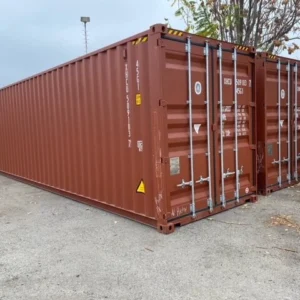
40 foot high cube Shipping container one
$5,350 Add to cart -
Shipping Containers
40 Foot High-Cube Insulated Shipping Container with 5 Ton Bard HVAC
$5,500 Add to cart -
Shipping Containers
40 ft Insolated Shipping Container
$6,900 Add to cart -
Shipping Containers
40′ HIGH CUBE SHIPPING CONTAINER
$7,500 Add to cart -
Shipping Containers
40ft Container 8.6ft Ceilings 8ft Wide like Never Used
$3,900 Add to cart -
Shipping Containers
40ft HC One Trip shipping container
$4,800 Add to cart -
Shipping Containers
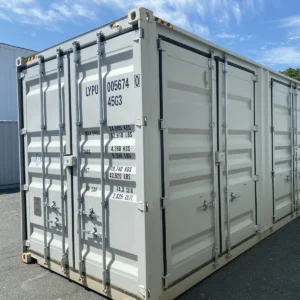
40ft High Cube New Shipping Container open side one trip
$9,000 Add to cart -
Shipping Containers
Sale!
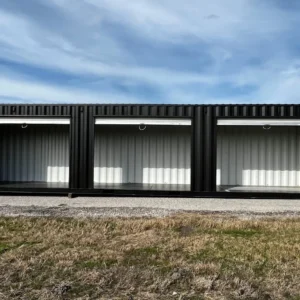
40ft Shipping Container w/3 Roll-Up Side Doors
Original price was: $9,950.$7,000Current price is: $7,000. Add to cart -
Shipping Containers
Sale!
NEW 2024 ULTRA CLEAN” Storage Container 40’x 8’x 9’6″ w/ “ULTRA EASY ACCESS
Original price was: $9,590.$7,300Current price is: $7,300. Add to cart -
Shipping Containers
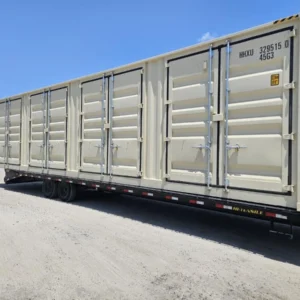
NEW 40ft High Cube Shipping Container – Open Side 4 Doors
$8,950 Add to cart -
Shipping Containers
New One Trip 40ft High Cube (HC) Shipping Container
$4,700 Add to cart -
Shipping Containers
New One Trip 40ft High Cube Open Side 4-Door Shipping Storage Container
$15,400 Add to cart
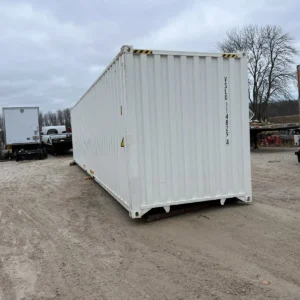

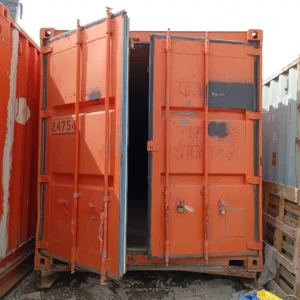
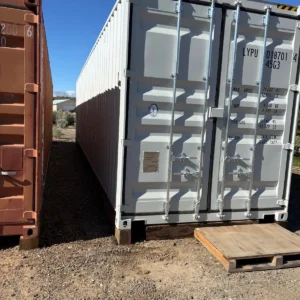
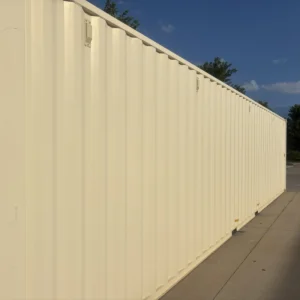
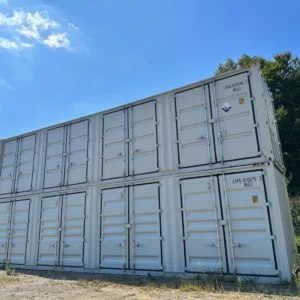
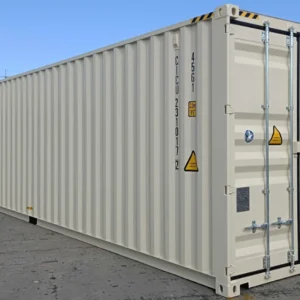
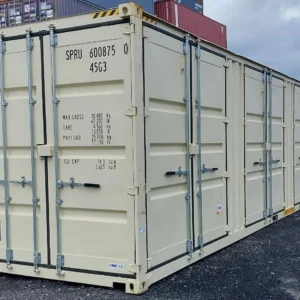
40ft Shipping Containers for Sale
The 40ft container is the best value per square foot on the market, and it is not close. You get roughly 302 sq ft of secured, weathertight floor for typically 30–50% more than a 20ft — meaning your cost per square foot lands well below half. If your site can take one, buy one.
That "if" is the whole story on this page. A 40ft box is not simply a bigger 20ft. It changes what truck can deliver it, how much room you need to unload, how it has to be blocked, and whether you will ever be able to move it again. We stock new one-trip and used wind & watertight 40ft units in both standard and high cube, and quote flat-rate freight anywhere in the lower 48.
Standard vs High Cube: the Headroom Decision
Both are 40ft long and 8ft wide. The high cube adds one foot of external height, and every bit of it goes to interior clearance and door opening.
| Specification | 40ft Standard | 40ft High Cube |
|---|---|---|
| External length | 40'0" | 40'0" |
| External width | 8'0" | 8'0" |
| External height | 8'6" | 9'6" |
| Internal length | 39'5" | 39'5" |
| Internal width | 7'8" | 7'8" |
| Internal height | 7'10" | 8'10" |
| Door opening (W × H) | 7'8" × 7'6" | 7'8" × 8'5" |
| Floor area | ~302 sq ft | ~302 sq ft |
| Internal volume | ~2,385 cu ft | ~2,694 cu ft |
| Tare (empty) weight | ~8,200 lb | ~8,750 lb |
| Max payload | ~59,000 lb | ~58,400 lb |
| Max gross weight | 67,200 lb | 67,200 lb |
Nominal figures for dry cargo units; the CSC plate governs any individual box. The high cube's 8'5" door opening is the number that matters most in practice — it is what lets a standard forklift mast, a lifted truck, or a small tractor drive straight in. It is also why high cubes dominate conversion work: after 4in of floor build-up and a framed ceiling you still have usable headroom, which you do not in a standard. Full measurements across every size are in our container dimensions guide.
The 100-Foot Rule: Getting a 40ft Delivered
This is where 40ft deliveries fail. A tilt-bed truck sets the container by raising its bed, sliding the box off the back on rollers, and driving forward out from under it. The truck and trailer alone are about 65–70ft. Add the container's own travel and you need roughly 100ft of straight, level, obstruction-free run behind the drop point, and about 150ft of total working length for the rig.
- No mid-course turns. The truck must approach in a straight line and leave in a straight line. A 40ft box cannot be swung into place. If your drop spot is around a corner, past a gate post, or up a switchback drive, a tilt-bed is out.
- Overhead clearance of 15ft. The bed tilts high. Power drops, tree canopy, and eaves are the three things that most often turn a truck around.
- 12ft of clear width minimum, more on the approach turn.
- Firm surface. A loaded 40ft rig runs well over 30,000 lb on the rear axles. Soft fill, wet clay, and new turf will sink it, and the recovery bill is yours.
- Six blocking points, not four. A 40ft frame will sag and rack if you only support the corners on uneven ground. Block the four corner castings plus the midpoints, and check that the doors still latch cleanly after it is set — that is your level indicator.
Where a tilt-bed cannot get in, the alternative is a flatbed plus a crane or a container-rated forklift, arranged before the truck leaves. Tell us at quote time and we will price it correctly rather than sending a truck that has to leave loaded.
Condition and What It Buys You
New one-trip 40ft units come with factory paint, clean marine-ply floors, and door seals that have not been baked for fifteen years — worth the premium if the box will be visible, converted, or expected to outlive you. Used wind & watertight 40ft boxes are the pragmatic buy for yard and job-site storage: cosmetically weathered, structurally sound, sealed against rain. Cargo worthy sits between the two and is what you want only if the box will actually be shipped again. Details on what each survey certifies are in our grades explained guide.
When a 40ft Is the Wrong Call
Two situations. First, access — covered above; a box that cannot be delivered is worth nothing regardless of price per square foot. Second, if you may need to relocate it. A 40ft is effectively permanent once set; moving it means a second delivery-grade truck and the same 100ft of clearance all over again. Buyers who reposition boxes regularly are better off with a 20ft, which most heavy forklifts and many tow operators can shift, or with a dedicated container chassis.
Related Categories
- 20ft shipping containers — half the length, far easier to site
- 45ft shipping containers — five more feet if you need the reach
- All shipping containers — every size we stock
- Container chassis and trailers — road-legal hauling for a 40ft box (what is a container chassis?)
- Flatbed trailers — for crane-set deliveries and long material
- Shop all inventory
Frequently Asked Questions
How much clearance do I need to have a 40ft container delivered?
Plan on about 100ft of straight, level run behind the drop point and roughly 150ft of total working length for the truck. You also need 15ft of overhead clearance for the tilt bed and 12ft of width. The truck cannot turn mid-delivery.
What is the difference between a 40ft standard and a 40ft high cube?
One foot of height. A high cube is 9'6" tall externally with 8'10" of interior headroom and an 8'5" door opening, versus 8'6" external and 7'10" interior on a standard. Floor area is identical at about 302 sq ft; the high cube adds roughly 300 cu ft.
How much does an empty 40ft container weigh?
About 8,200 lb for a 40ft standard and roughly 8,750 lb for a high cube. Exact tare varies by manufacturer and build year and is stamped on the CSC plate at the door. Maximum gross weight is 67,200 lb, giving roughly 59,000 lb of payload.
How many pallets fit in a 40ft container?
About 20 to 21 standard 48x40 US pallets floor-loaded in a single layer, roughly double a 20ft. Euro pallets fit 24 to 25. Double-stacking raises those numbers but is limited by your load height and the 7'10" interior on a standard unit.
Can a 40ft container be moved after it is placed?
Yes, but it requires the same tilt-bed truck and the same 100ft of clearance as the original delivery, so treat placement as permanent. Most forklifts cannot lift a 40ft box safely. If you expect to relocate it often, a 20ft or a container chassis is the better buy.
Is one 40ft container cheaper than two 20ft containers?
Almost always, on both purchase and freight. A 40ft typically costs 30 to 50 percent more than a single 20ft while giving double the floor, and it ships on one truck instead of two. The trade-off is site access, which is far more demanding.