
Tilt Deck Trailers
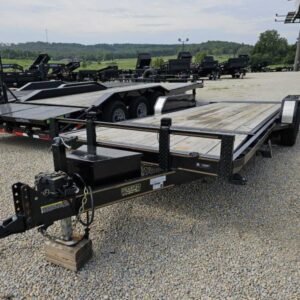
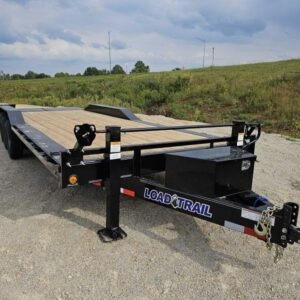
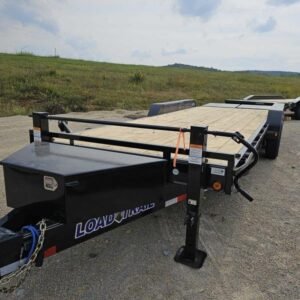
There are no ramps on a tilt deck. That is the entire pitch, and after one season of loading you understand why people pay for it. Nothing to unpin, nothing to drag out from under the frame, nothing to lift back into place in the rain, and nothing to steal off the tail overnight. The deck itself pivots on a center hinge, touches down at the rear, and the machine drives on at a shallower angle than any set of slide-in ramps can produce.
Tilt Deck Trailer Sizes & Capacities
Load angle is the number that separates a tilt deck from an equipment trailer, so it is in the table. Angles vary with deck length, deck height, and pivot position — a longer deck on the same hinge produces a shallower angle, which is why a 22-footer loads easier than a 16-footer of the same rating.
| Deck size | Axles | GVWR | Typical load angle | Best suited to |
|---|---|---|---|---|
| 16' × 82" | 2 × 5,200 lb | 9,990–10,400 lb | 10–12° | Compact tractors, ATVs, one small vehicle |
| 18'–20' × 82" | 2 × 7,000 lb | 14,000 lb | 9–11° | Skid steers, mini excavators, lowered cars |
| 20' × 83" | 2 × 8,000 lb | 16,000 lb | 9–11° | Compact track loaders, forklifts |
| 20'–22' × 102" deckover | 2 × 8,000–10,000 lb | 16,000–20,000 lb | 8–10° | Wide equipment, scissor lifts, pallets of material |
| 24' × 83"–102" | 3 × 7,000–8,000 lb | 21,000–24,000 lb | 8–10° | Two-machine loads, heavier tracked equipment |
For context on why that matters: a standard 5-foot slide-in ramp against a 21-inch deck works out to roughly a 20-degree approach, and even 6-foot ramps land near 16 degrees. Tilt decks live in the 8 to 12-degree band. Low-clearance loads that hang up on ramps clear a tilt deck without argument.
How the Tilt Mechanism Works
Most tilt decks are gravity tilt with a hydraulic cushion cylinder. You release a latch, the load's own weight or your body weight past the pivot rotates the deck down, and the cushion cylinder meters the descent through an adjustable orifice so the deck settles instead of slamming. Driving the load forward past the hinge brings the deck back level, where the latch re-engages. There is no pump, no battery, and very little to fail — you maintain the cylinder, the hinge pins, and the latch, and that is roughly the list.
Power tilt models add a 12-volt electric-over-hydraulic pump and a deep-cycle battery so the deck is raised and lowered under control from a corded pendant or wireless remote. Worth it if you load and unload dead machines, non-runners, or anything that cannot be driven forward past the pivot to reset the deck.
The other split is full tilt versus partial tilt. A full-tilt deck pivots end to end. A partial tilt, sometimes called a stationary-deck tilt, keeps the forward 4 to 8 feet fixed and level while only the rear section rotates. Partial tilt is the smarter choice when you regularly haul two pieces — put the attachment, the toolbox, or the second machine on the stationary section where it stays put, and use the tilting portion for the load you drive on. Full tilt gives you a completely flat, uninterrupted deck when level, which matters for long material.
Watch the pivot clearance on tall loads. Because the deck articulates, anything overhanging the front of the deck sweeps downward relative to the frame as the tail comes up. It is rarely a problem with equipment and occasionally a problem with tall boxed loads.
How to Choose the Right Tilt Deck Trailer
Confirm the machine can drive itself on and off
Tilt decks assume a self-propelled load. If you are loading pallets with a forklift, dropping material off the side, or winching a non-runner, a gravity tilt fights you. Buy power tilt or buy a conventional deck.
Deck length drives your load angle more than deck height does
If your lowest machine is the constraint, buy longer rather than trying to shave deck height. Going from 18 to 22 feet on the same chassis meaningfully flattens the approach.
Between-fender versus deckover
An 82 to 83-inch deck between fenders keeps the deck low. A 102-inch deckover gets you full width for wide buckets and lifts at the cost of a few inches of height. Wide equipment wins that argument almost every time.
Match GVWR to the heaviest single machine, plus its attachments
A 14,000-pound tilt weighs roughly 3,600 to 4,200 pounds empty, leaving about 10,000 pounds of payload. A compact track loader with a bucket and a set of forks can push 11,000. Run the numbers with GVWR and payload explained.
Brakes and tires for the real load
Electric brakes on both axles are standard; above 16,000 pounds, consider hydraulic disc. Verify your state's requirements in trailer brake laws by state, and confirm tire load range matches the axle rating rather than the trailer's advertised capacity.
Delivery & Buying Online
Tilt decks ship nationwide to the lower 48 with flat-rate freight quoted to your address before purchase — the delivered price is locked when you commit, not adjusted afterward. Every unit is covered by our 30-day guarantee. Tell us the machine, its ground clearance, and your tow vehicle, and we will confirm the deck length and angle work before it leaves Wickenburg.
Related Categories
If you need a flat deck at rest plus a low load angle, compare our hydraulic dovetail trailers, where only the tail folds down. Traditional ramp-loaded units are in equipment trailers and flatbed trailers. For hauling vehicles specifically, see car hauler trailers, and if you are still deciding on trailer type, read dump vs equipment vs utility trailer.
Frequently Asked Questions
What load angle does a tilt deck trailer give you?
Most tilt decks load between 8 and 12 degrees, depending on deck length, deck height, and pivot position. Longer decks produce shallower angles. By comparison, standard 5-foot slide-in ramps against a 21-inch deck give roughly 20 degrees, which is why low-clearance machines and lowered vehicles load far more easily on a tilt.
How does a gravity tilt deck return to level?
You drive the load forward past the center pivot and the deck rotates back down under the load's weight, where a latch re-engages. A hydraulic cushion cylinder meters both directions through an adjustable orifice so the deck settles rather than slams. No pump or battery is involved on a standard gravity tilt.
What is the difference between full tilt and partial tilt?
A full-tilt deck pivots end to end and gives a completely flat, uninterrupted deck when level. A partial or stationary-deck tilt keeps the front 4 to 8 feet fixed while only the rear section rotates, so attachments, toolboxes, or a second machine stay put on the level section during loading.
Can I haul a non-running vehicle on a tilt deck trailer?
Yes, but you want power tilt rather than gravity tilt. A gravity deck relies on the load being driven forward past the pivot to return level, which a dead vehicle cannot do. Power tilt models use a 12-volt electric-over-hydraulic pump so you control deck position independently of the load.
Tilt deck or hydraulic dovetail: which should I buy?
Choose a tilt deck if your loads drive on and off and you want the simplest mechanism with the fewest failure points. Choose a hydraulic dovetail if you need the main deck to stay flat and level while loading, or you also haul pallets and long material that a pivoting deck complicates.
How much does a tilt deck trailer weigh empty?
A 14,000-pound GVWR tilt deck typically weighs 3,600 to 4,200 pounds empty, leaving roughly 10,000 pounds of payload. A 16,000-pound unit runs 4,200 to 4,800 pounds, and 21,000 to 24,000-pound triple-axle decks run 5,500 to 7,000 pounds. Confirm the figure on the specific unit's VIN plate.