
Utility Trailers
Showing 109–112 of 112 results
-
Aluminum Utility Trailers
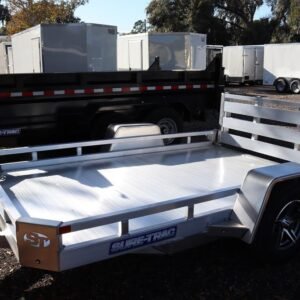
7X10 Aluminum Low Side 3K Utility
$10,000 Add to cart -
Aluminum Utility Trailers
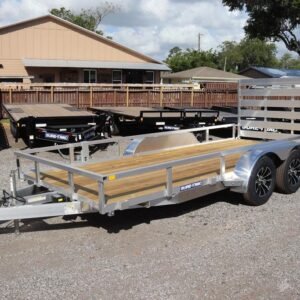
7X16 Aluminum Tube Top Utility Trailer with Spare Carrier
$6,450 Add to cart -
Utility Trailers
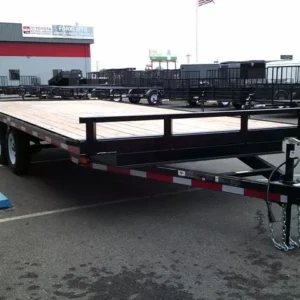
8.5 X 18 Carry-On Deckover 7K Trailer
$5,869 Add to cart -
Utility Trailers

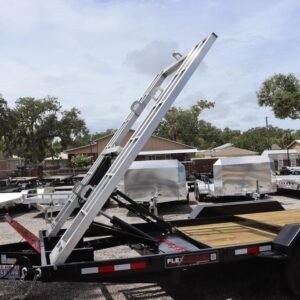
8.5×20 Tandem Axle Flex Hauler Side by Side Trailer (2026)
$14,755 Add to cart
Utility Trailer Sizes & Capacities
Utility trailers are the open-deck workhorse of the towing world: a rail, a deck, one or two axles, and a ramp. Nearly every buying decision comes down to two numbers — the deck size you need and the GVWR rating stamped on the VIN plate. GVWR is the total the trailer is legally rated to weigh loaded, so your usable payload is GVWR minus the trailer's own empty weight. A 7,000 lb tandem that weighs 1,900 lb empty gives you roughly 5,100 lb of cargo, not 7,000.
| Deck Size | Axle Setup | Typical GVWR | Usable Payload | What It's Really For |
|---|---|---|---|---|
| 4' x 8' / 5' x 8' | Single 2,000–3,500 lb | 2,000–2,990 lb | 1,300–2,100 lb | Push mowers, moving boxes, dump runs behind an SUV |
| 5' x 10' / 6' x 10' | Single 3,500 lb | 2,990 lb | 1,800–2,200 lb | ATVs, single zero-turn, light landscape work |
| 6' x 12' | Single 3,500 lb | 2,990 lb | 1,700–2,000 lb | Two-mower crews, furniture, side-by-sides |
| 6' x 12' / 6.5' x 14' | Tandem 3,500 lb | 7,000 lb | 4,900–5,400 lb | Pallets, firewood, small tractors, highway miles |
| 7' x 14' / 7' x 16' | Tandem 3,500 lb | 7,000 lb | 4,700–5,200 lb | Landscape fleets, materials, general contracting |
| 7' x 16' / 7' x 18' | Tandem 5,200 lb | 9,990 lb | 7,300–7,900 lb | Compact track loaders, mini excavators, skid steers |
| 8.5' x 20' | Tandem 7,000 lb | 14,000 lb | 10,000–11,200 lb | Equipment hauling — effectively a light flatbed |
Note the jump at 9,990 lb. Manufacturers stop just under 10,000 lb deliberately, because crossing that line pushes a lot of owners into commercial registration, DOT numbers, and different licensing rules depending on the state and how the trailer is used.
How to Choose the Right Utility Trailer
Start with the heaviest thing you'll ever load
Not the average load — the worst one. Add 20% for the mud, fuel, attachments, and tools that ride along. That number sets your GVWR class, and everything else follows from it.
Match the trailer to the truck, not the other way around
A half-ton pickup is usually good for a 7,000 lb tandem with a weight-distributing setup; loaded past that you are into 3/4-ton territory. Check the tow rating on your door jamb and remember that 10–15% of the loaded trailer weight lands on the hitch as tongue weight, which eats into payload capacity.
Single axle or tandem
Single-axle trailers are lighter, cheaper, easier to hand-maneuver in a driveway, and cost half as much in tires and bearings. Tandems track straighter at highway speed, carry roughly double, and get you home on the remaining axle if a tire lets go. If most of your towing is over 45 mph or over 3,000 lb, buy the tandem.
Deck width and ramp style
A 60" deck fits a zero-turn; 77"–83" between the fenders fits most compact tractors and side-by-sides. Ramp gates that fold flat into the deck open up the whole length; slide-in ramps stay out of the way but need somewhere to store. Mesh gates load mowers cleanly, solid gates stop debris from falling through.
Steel or aluminum
This is the fork in the road. Steel utility trailers cost less up front and take abuse without complaint. Aluminum utility trailers weigh 400–800 lb less in the same size, never rust, and hold resale value — for a premium of roughly 30–50%. If you tow with a smaller vehicle, live where roads get salted, or plan to keep the trailer a decade, aluminum pays back. If you're loading rock and scrap for a living, buy steel.
Frames, Axles, and Brakes
Frame construction tells you more about a trailer than the price tag. Look for a tube or channel main frame rather than light angle iron, crossmembers on 16" or 24" centers rather than 36", and a tongue that is either an A-frame or a straight channel wrapped and welded on both sides. Wiring run inside the frame tube survives far longer than wiring stapled to the underside.
Axles are almost always Dexter, Lippert, or an equivalent, in 3,500 lb, 5,200 lb, 6,000 lb, and 7,000 lb ratings. Drop axles gain ground clearance; straight axles keep the deck low. Brakes are required by most states once GVWR passes 3,000 lb — some set the threshold at 1,500 lb and a few at 4,000 lb, so check your own statutes. Electric drum brakes (10" x 2.25" on 3,500 lb axles, 12" x 2" on 5,200–7,000 lb axles) are standard, and a breakaway kit with a charged battery is required any time electric brakes are fitted.
Decking is the part that wears out first. Pressure-treated pine is the budget standard and lasts 5–8 years outdoors. Rough-cut oak resists gouging from tracked equipment. Extruded aluminum plank never rots and adds no weight. Whatever you buy, keep the deck drained and don't tarp it wet.
Delivery & Buying Online
We ship utility trailers to all 48 contiguous states on flat-rate freight quoted before you commit — no surprise line items at delivery. Every trailer is covered by our 30-day guarantee, and our team will walk you through GVWR, tow ratings, and hitch class before you order if you're unsure which size fits your truck.
Related Categories
Working through the options? Compare steel utility trailers against aluminum utility trailers on weight and cost, step up to equipment trailers with stand-up ramps if you're hauling machinery, look at dump trailers when unloading by hand becomes the bottleneck, or move to enclosed cargo trailers when your load needs to stay dry and locked. Replacement axles, couplers, and lights live in trailer parts.
Frequently Asked Questions
What size utility trailer do I need for a zero-turn mower?
A 6' x 12' single-axle utility trailer handles most zero-turn mowers up to a 60" deck. If you run two mowers plus a string trimmer rack and blowers, move to a 7' x 14' tandem with a 7,000 lb GVWR so you have both the length and the payload margin.
Do I need brakes on a 7,000 lb utility trailer?
Yes. Every state requires brakes at 7,000 lb GVWR, and most set the threshold at 3,000 lb. A 7,000 lb tandem normally comes with electric drum brakes on both axles, plus a breakaway kit. You'll also need a brake controller installed in your tow vehicle.
How much does a 7x14 utility trailer weigh empty?
A steel 7' x 14' tandem-axle utility trailer weighs roughly 1,800 to 2,300 lb empty, depending on frame gauge, decking, and gate. The aluminum equivalent runs about 1,300 to 1,600 lb. Subtract that empty weight from the GVWR to get your real payload.
Can a half-ton truck pull a tandem-axle utility trailer?
Most half-ton pickups can pull a 7,000 lb tandem utility trailer, but check the tow rating on your door jamb and your payload sticker. Tongue weight runs 10 to 15% of the loaded trailer, so a fully loaded 7,000 lb trailer puts 700 to 1,050 lb on the hitch.
What's the difference between GVWR and payload on a trailer?
GVWR is the maximum the loaded trailer is rated to weigh, including the trailer itself. Payload is GVWR minus the trailer's empty weight. A 9,990 lb GVWR trailer weighing 2,400 lb empty carries about 7,590 lb of cargo, not 9,990 lb.
Should I buy a single-axle or tandem-axle utility trailer?
Buy tandem if you tow highway speeds or haul over 3,000 lb. Tandems track straighter, carry roughly double, and won't strand you if one tire fails. Single axles are lighter, cheaper to maintain, and far easier to push around by hand in a tight driveway.